For more information on gum disease contact one of our dental professionals at.
Dentist Brampton
905-458-6620


1. The enamel on the top surface of your tooth is the hardest part of your entire body.
2. An average person spends 38.5 days brushing their teeth over their lifetime.
3. An average human being has around 32 teeth. This includes four wisdom teeth, eight incisors, four canines, twelve molars and eight premolars
4. Today, around forty percent of people over 65 years do not have a complete set of teeth.
5. The ancient Greeks used pliers for teeth extractions.
6. In Germany, a common Middle Age custom was to kiss a donkey to relieve toothaches.
7. The ancient Chinese usually wrapped tiny parchment around their painful teeth which contained written incantations and prayers to relieve pain
8. Originally, the bristles of a toothbrush were made of cow hairs.
9. The first commercial dental floss was made in the year of 1882.
10. Most people prefer to use blue toothbrushes than red ones!

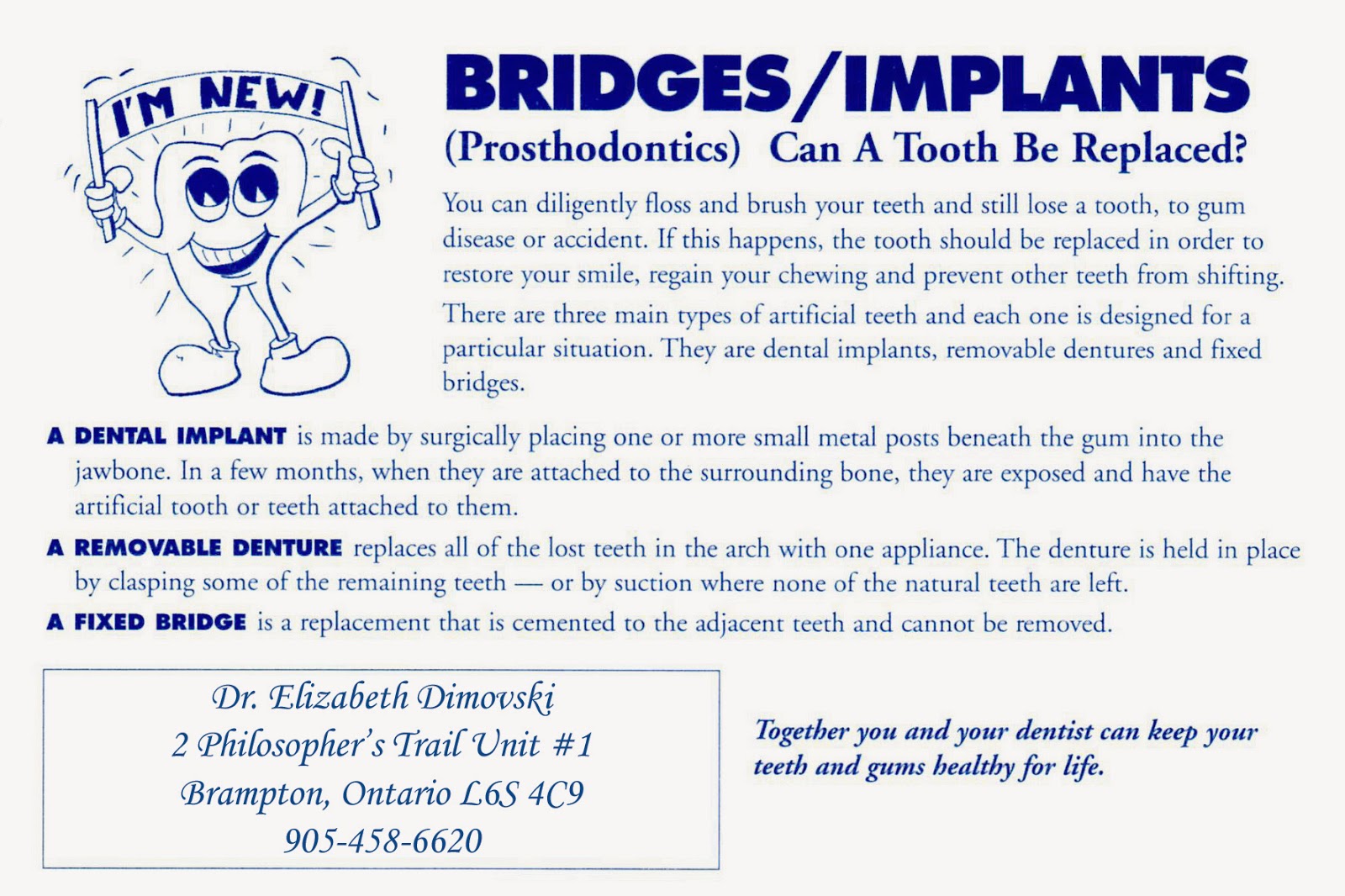
Can A Tooth Be Replaced?
You can diligently floss and brush your teeth and still lose a tooth, to gum disease or accident. If this happens, the tooth should be replaced in order to restore your smile, regain your chewing and prevent other teeth from shifting. There are three main types of artificial teeth and each one is designed for a particular situation. They are dental implants, removable dentures and fixed bridges.
A DENTAL IMPLANT is made by surgically placing one or more small metal posts beneath the gum into the jawbone. In a few months, when they are attached to the surrounding bone, they are exposed and have the artificial tooth or teeth attached to them.
A REMOVABLE DENTURE replaces all of the lost teeth in the arch with one appliance. The denture is held in place by clasping some of the remaining teeth or by suction where none of the natural teeth are left.
A FIXED BRIDGE is a replacement that is cemented to the adjacent teeth and cannot be removed.
For more information on these or other topics be sure to contact one of our dental professionals.

To help the dental visit go more smoothly:
1. Tell your child about the visit but limit the amount of details given.
2. Answer any questions with simple, to-the-point, answers. Let the dentist answer more complex or detailed questions as dentists are trained to describe things to children in a non-threatening and easy-to-understand language.
3. Be careful of the words that you use such as “hurt” and “pain.”
4. Be sure not to tell your child about an unpleasant dental experience that you’ve had.
5. Explain things in a matter that they’ll understand how important it is to maintain healthy teeth and gums and that the dentist is a friendly doctor whose job it is to help do this.
6. Don’t promise a reward for going to the dentist.
Ways a dentist can calm an anxious child:
1. Voice control. The dentist uses a friendly voice, which could become firmer if necessary.
2. Simple instructions. The dentist will use simple words (tell, show, do) to explain a procedure and may demonstrate the procedure on a doll or another person before performing the procedure on the child.
3. Positive reinforcement. The dentist will use praise and compliments to reward for good behaviour.
4. Distraction. The dentist will tell stories or engage the child in conversation to draw the child’s attention away from the work being completed.
5. Nonverbal communication. The dentist uses body language, such as a simple smile to reinforce positive behaviour.
6. Sedation. The dentist may use sedation to help the child relax and be more comfortable, if necessary. The two most common types of sedation that might be used in children are nitrous oxide (“laughing gas”) or an oral sedative (such as Valium).
 Dr. Elizabeth Dimovski - Brampton Dentists